In perioada ianuarie-mai, exporturile Romaniei au scazut cu 21% fata de aceeasi perioada a anului trecut, ajungand la 11 miliarde euro, situandu-se pe pozitia 22 in randul statelor comunitare, potrivit datelor Eurostat.
In iunie, deficitul comercial al Romaniei in relatiile cu partenerii din afara UE a fost de 200 milioane euro, al noualea din Uniune, contribuind, astfel, la deficitul de 7,7 miliarde euro al blocului comunitar.
Cele mai mari deficite comerciale le-au avut Marea Britanie (38 miliarde euro), Franta (24,4 miliarde euro) si Spania (20,7 miliarde euro). Germania fost liderul european la capitolul excedent comercial (46,3 miliarde euro), urmata de Irlanda (15,6 miliarde euro) si Olanda (13,8 miliarde euro).
Deficitul comercial al Uniunii a fost, in perioada ianuarie-mai, de 61,3 miliarde euro, reflectand o scadere de 21% a exporturilor, la 427,4 miliarde euro, si o reducere de 23% a importurilor, la 490,5 miliarde euro.
Germania a fost si cel mai mare exportator din UE (323,1 miliarde euro), pe urmatoarele doua pozitii plasandu-se Olanda (141,6 miliarde euro) si Franta (137,8 miliarde euro). Valoarea exporturilor a scazut, in perioada analizata, in toate statele blocului comunitar, iar cele mai accentuate declinuri au fost inregistrate in Finlanda (37%), Suedia (32%) si Bulgaria (31%).
Importurile au scazut, de asemenea, in toate tarile Uniunii. Cele mai mari diminuari ale indicatorului le-au avut Lituania (44%), Letonia (39%) si Estonia (37%).
Gandul scrie ca fiscul vrea sa ia la bani marunti piata imobiliara din Romania, din perioada de maxima efervescenta, iar pe lista de verificari se afla Becali si fratii Negoita.
Ziarul financiar scrie despre lupta PDL cu criza, de la scutirea profitului reinvestit si vanzarea participatiilor de stat la extinderea ajutorului de minimis pentru IMM-uri si investitiile in mediu si irigatii.
Evenimentul zilei precizeaza ca noua lege a salarizarii va duce la un paradox: ce se castiga acum prin disponibilizari masive din sectorul de stat se va pierde odata cu marirea lefurilor celor ramasi.
Cotidianul scrie ca numarul bugetarilor din administratiile locale va fi stabilit in functie de numarul de locuitori din fiecare oras si comuna, potrivit standardelor unitare de cost pentru administratiile locale discutate de ministrii Finantelor si Administratiei cu liderii din teritoriu.
Romania Libera precizeaza ca pentru achizitia unei locuinte cu ajutorul unui credit prin "Prima Casa" trebuie sa aveti pregatita o suma echivalenta cu 10-11% din valoarea locuintei, din care 4% costuri colaterale.
Adevarul afirma ca librariile online de carte straina sunt o afacere de nisa pe care se bat putine nume, in conditiile in care romanii sunt din ce mai interesati de cartile in limbi straine.
At the beginning of this year, in the midst of pessimistic economic forecasts and with the recent experience of the October depreciation of the RON, many experts (and BUSINESS Magazin readers, as well) were willing to believe it would be difficult to avoid an evolution of the exchange rate towards 5 RON/euro in the first half of the year. However, when we asked bankers in January to give us an exchange rate projection, not only none of them predicted a rate of over 4.50 RON/euro, but the majority went no further than 4.30 or even 4.10 RON/euro.
Eventually, reality matched the bankers’ predictions, with the exchange rate remaining at 4.2067 RON/euro on June 30 – decidedly very far from the ideal levels of 3.1 RON/euro in the summer of 2007, but also very remote from the apocalyptic scenarios of 5 RON/ euro or even higher. Now, history seems to repeat itself: after forecasts on the economic progression have changed several times over the last few months, and an 8% economic decline has become an official scenario, while the budget deficit is widening day after day, a collapse of the RON is something that many Romanians, especially those with loans in euros, continue to fear. In this context, it could be considered surprising that most commercial banks officials who agreed to answer BUSINESS Magazin’s questions gave moderate predictions that start from 4.1 RON/euro, and only on a few occasions reach 4.50 RON/euro.
The explanation lies mainly with the fact that the main pressure factor on the RON last year, the large balance of payments deficit, lost its impact due to the crisis, which caused a slowdown in economic activity and, implicitly, generated a decline in imports. ”The adjustment of the balance of payments’ current account is significant, from 12.5% last year to less than 6%, perhaps even 4% this year – and has been more than 100% covered via foreign direct investment,” says Mihai Bogza, chairman and CEO of Bancpost. However, Bogza says that if the economic policies implemented by the authorities do not fall within the limits agreed with the IMF, the external perception will be that Romania’s economic imbalance will deepen again.
And, if, under such a scenario, the IMF would cut off its funding, meant to pad the Romanian National Bank’s foreign exchange reserve, ”it is easy to imagine a scenario where foreign pressure on the exchange rate would escalate so much as to make the current level difficult to safeguard by the central bank,” says Mihai Bogza. As for how the Romanian economy will be affected by the evolution of the crisis worldwide, most bankers see the quality of economic policies to be implemented by the authorities as being decisive, a quality that cannot be judged without taking into consideration the risks posed by the electoral context of the next few months.
Vanzarile de masini noi mai scumpe de 100.000 de euro au scazut in primul semestru la o treime fata de aceeasi perioada din 2008, la mai putin de 60 de unitati, segmentul de lux avand astfel un declin mai puternic decat piata generala a automobilelor, care s-a injumatatit in perioada analizata.
Livrarile marcilor premium si de lux s-au redus in ansamblu la mai mult de jumatate in primul semestru din acest an, fata de aceeasi perioada a anului trecut, cu mici exceptii, declinul fiind temperat de cererea pentru masinile mai ieftine din gama fiecarui constructor premium, reiese din datele Asociatiei Producatorilor si Importatorilor de Automobile (APIA) din Romania.
Pe o piata a autoturismelor care a scazut cu 51,3% la sase luni, fata de perioada corespunzatoare a anului trecut, la 70.610 unitati, Audi a avut vanzari in scadere cu 52,6%, BMW cu 61,1%, iar Jaguar cu 72,3%. De asemenea, livrarile Maserati au scazut cu 71,4%, cele ale Mercedes-Benz s-au redus cu 42,6%, iar Porsche a scazut cu 57,6%.
Vanzarile modelelor care au un pret de catalog mai mare de 100.000 de euro au scazut de trei ori in primul semestru, la sub 60 de unitati, fata de intervalul corespunzator al anului trecut, cand au fost comercializate peste 160 de masini care trec de aceasta valoare.
Cititi mai multe despre vanzarile de masini de peste 100.000 euro pe www.mediafax.ro.
Cititi mai multe despre cele mai scumpe masini vandute in Romania pe www.businessmagazin.ro.
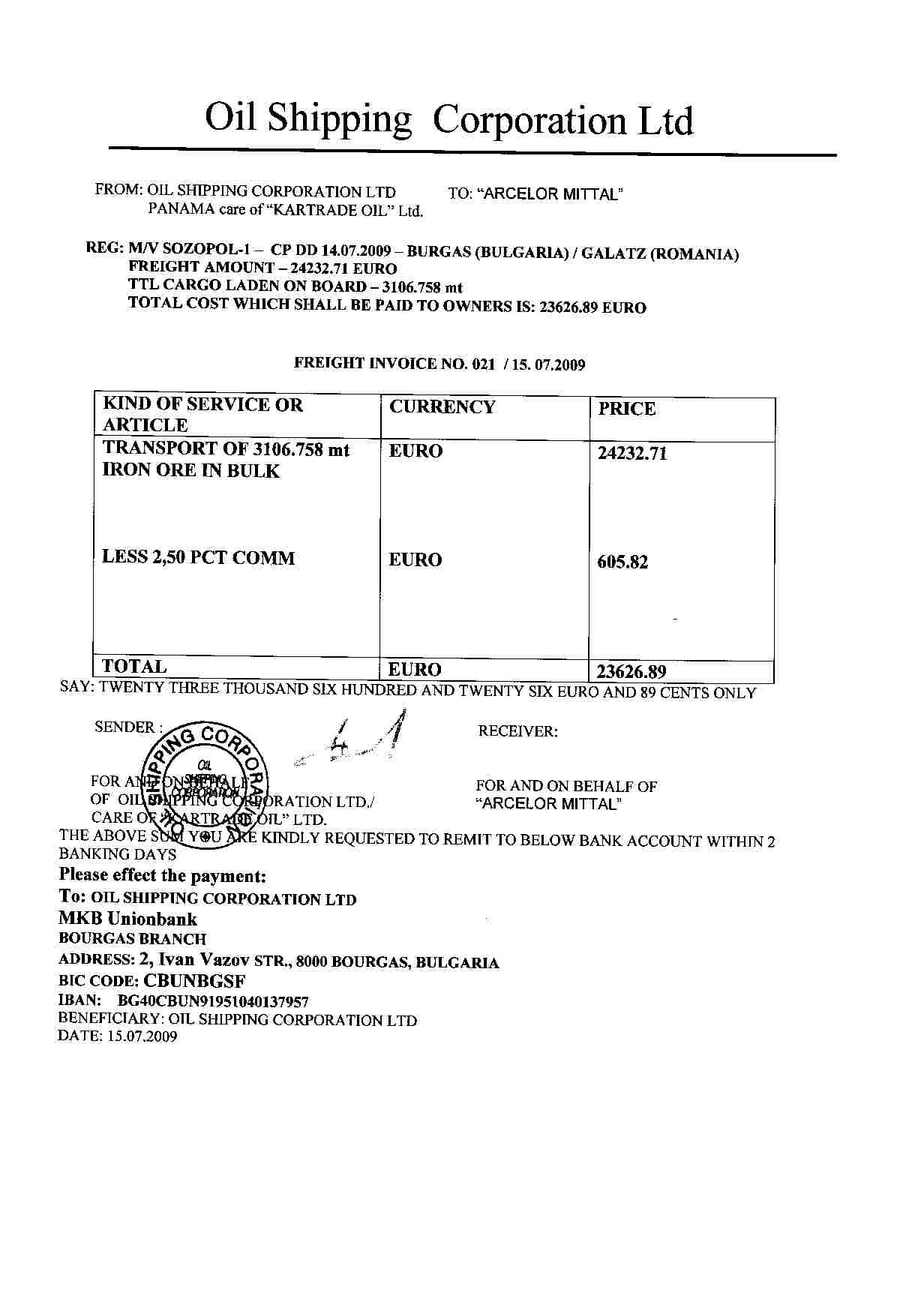
Astfel, conform unei ştiri recente a agenţiei naţionale de presă Agerpres, Grupul Arcelor Mittal a derulat contracte de transport de materie primă din portul bulgăresc Burgas către Galaţi, pe ruta Marea Neagră – Canalul Bâstroe, ignorând portul Constanţa şi lovind astfel în interesele economice ale României.
Conform unui asemenea contract (redactat în limba engleză, din care sunt prezentate mai jos extrase în facsimil), Grupul Arcelor Mittal negociază, pe data de 13 iulie 2009, transportul unei cantităţi de minereu de fier din Burgas spre Galaţi, pe o navă bulgărească denumită Sozopol, la un preţ de 7,80 euro/tonă/
Facsimilul de mai jos e relevant: marfa transportată e minereu de fier (căsuţa 12), destinatarul mărfii e Arcelor Mittal Galaţi (căsuţa 4), portul de încărcare este Burgas (căsuţa 10), portul de descărcare este Galaţi (căsuţa 11), nava transportatoare este bulgărească şi se numeşte Sozopol 1 (căsuţa 5), are o capacitate de 3.261 tone dw (căsuţa 7) şi realizează transportul la un preţ de 7,80 euro/tonă (căsuţa 13), la care se vor adăuga costuri de încărcare/descărcare şi alte cheltuieli auxiliare.
Aceste lucruri se petrec în condiţiile în care terminalele aflate în Portul Constanţa pot acosta nave cu capacităţi de până la 220.000 tone dw (ceea ce ar reduce costurile de operare a mărfurilor), în timp ce viteza de încărcare/descărcare la aceste terminale este de cel puţin două ori mai mare decât cea din Burgas (ceea ce din nou ar reduce din costuri). Aceste avantaje ale Portului Constanţa în raportul cu Portul Burgas duc la un cost al transportului de materie primă de 5,77 euro/tonă, în timp ce prin Burgas acest cost se poate ridica la 16-19 euro/tonă (cu toate cheltuielile incluse).
Sunt neclare motivele care au determinat Arcelor Mittal să prefere în ultimele luni de zile transportul mai scump şi mai lent de minereu de fier pe ruta Burgas – Canalul Bâstroe – Galaţi în dauna celui tradiţional şi eficient de pe ruta Constanţa – Canalul Dunăre–Marea Neagră – Galaţi. Oricare ar fi aceste motive, consecinţele practicilor anticoncurentiale ale Arcelor Mittal sunt clare: lipsă de activitate în Portul Constanţa şi pe Canalul Dunăre–Marea Neagră, venituri în scădere la bugetul de stat, salarii reduse şi şomaj pentru forţa de muncă din judeţul Constanţa.
Se constată că Grupul Arcelor Mittal practică astfel, cu bună ştiinţă, o politică total ostilă faţă de statul român, care a oferit facilităţi acestui grup ulterior privatizării SIDEX Galaţi şi continuă să-i ofere diverse avantaje şi în actuala perioadă de criză economică.
Grupul Arcelor Mittal are obligaţia să îşi reconsidere de îndată poziţia şi să revină la practici concurenţiale şi comerciale corecte, încetând atacurile la adresa Companiei Naţionale „Administraţia Porturilor Maritime” Constanţa, a Companiei Naţionale „Administraţia Canalelor Navigabile” şi a agenţilor economici români implicaţi în transportul de materie primă importată. Atitudinea arogantă a Arcelor Mittal nu serveşte nimănui şi va fi cu siguranţă penalizată în urma investigaţiei declanşate deja de Consiliul Concurenţei din România.
Contractul comercial dintre Arcelor Mittal Galaţi şi Kartrade Oil Ltd. Burgas împreună cu factura emisă de Kartrade Oil Ltd. către Arcelor Mittal pot fi consultate mai jos:
Comercializarea modelului pe piata locala a inceput la nivelul lunii iunie, initial fiind vandut in paralel cu generatia anterioara pana la epuizarea stocurilor acesteia.
Pretul de pornire al noului Polo este de 10. 552 de euro, cu TVA inclusa, 16.998 de euro, in cazul echiparii de top Highline si a motorizarii diesel de 1,6 litri cuplata la o cutie de viteze automata de tip DSG.
"Romania are sanse mari sa ajunga in top zece tari europene producatoare de autovehicule pana in 2012, in contextul in care Ford va produce asa cum a spus", a spus Ernest Popovici, presedintele Asociatiei Producatorilor si Importatorilor de Automobile (APIA).
Dacia are in plan, potrivit jucatorilor din piata, sa ajunga in anii urmatori la o productie de 300.000 de autovehicule anual, la care se vor adauga cele aproximativ 200-300 de mii de masini produse de Ford la Craiova, ceea ce ar determina un total de peste 600.000 de unitati, comparabil cu cel al Turciei din 2008, care ocupa locul noua.
Romania’s economy is functional and on the rise; next year we will start spending the money from the EU, especially for infrastructure investments, so that we will not have to deal with the depreciation of the economic growth. It is not us saying it now, President Basescu did it last autumn. It was October 21, a little while after the speculations on the forex market that had caused the RON to depreciate suddenly and one month before the parliamentary elections. Coincidentally, on the same day, Premier Tariceanu stated that Romania would post a 4 to 6% economic growth in 2009.
Back then, as well as now, the way businesspeople and authorities treat the economic information, the events happening before their eyes – in the US, in Europe and here at home, is the first step in the battle against the crisis. Those who look for the information and take advantage of it always stand to gain; those who ignore it either cannot shield themselves from the crisis, or (in the case of the government) only manage to prolong the dangerous illusion that the crisis will eventually pass on its own – unless it has already done so.
”Honestly, I didn’t imagine the situation in America would have such powerful effects in Europe, too, and especially in Romania,” admits Florentin Banu, the man who developed the Joe wafers brand and the Artima supermarkets. ”As proof that I did not anticipate it, I am now reeling from the heavy blow in terms of not only my real estate investments, but also of the plastic business.” Banu controls Banuconstruct, which develops apartment blocks in Timisoara and the plastic and mould factory Interpart Production.
”Unfortunately for me, I did not anticipate the crisis. When trouble started on the American real estate market I thought there might be repercussions on the Romanian real estate market, too, but nothing more,” Cosmin Alexandru, founder of branding consultancy Brandivia and cofounder of Erudio, in his turn admits.
Another man who paid attention to the real estate market was Marius Stancescu, chairman of business services firm Riff Holding, to whom, however, the obvious price bubble fuelled by the boom of cheap loans reminded of the Japanese crisis in the eighties, so that he started to ”stubbornly” look for information on similar situations in other parts of the world – South America, South-East Asia, where the overheating of the economies in the nineties caused the well-known crises of the time. ”I found lots of similar events to what was happening in the US and obviously to what was going to happen on the old continent,” he says, confessing he had tried to warn as may Romanian entrepreneurs as he could about what was going to happen, but to no avail, precisely because things looked so good in our country, that the possibility of a crisis seemed out of the question.
Among those who anticipated the crisis would be imported in Romania, as well, was Marius Sfintescu, manager of private equity fund 3TS Capital. ”I anticipated we would see the expansion of the US crisis to the entire world, including Romania. I used the specialised media as a source of information.” Which is why Sfintescu was one of the few business people who agreed to answer BUSINESS Magazin’s question about what his opinion on the policy of the foreign governments in dealing with the crisis; whether he felt that the relaxation of the monetary policy was too slow in Germany or France, considering the deflationary climate and whether it was important from now on for the developed states to concern themselves with the reduction of the monetary mass in good time in order to avoid a stagflation friendly environment in 2011.
TRADUCERE DE LOREDANA FRATILA-CRISTESCU SI DANIELA STOICAN
There ís nowhere like home, and the economic growth of the last few years made todayís Romania different from the Romania of the nineties: sufficient premises for a Romanian who left the country to want to come back. Still, the gap between reality and expectations of those who returned after a few years in London or on the Wall Street is still wide.
”If I did not leave the country on business trips once every few months, I think I would go crazy. This is my chance, being able to travel a lot,” Andreia Stavarache, 36, says frankly. She left for the United States through a programme of internship with audit and consultancy firm PricewaterhouseCoopers (PwC) at the beginning of 2000.
Stavarache had applied for an internship with PwC in Bucharest and had been turned down for being insufficiently experienced. “Those at Stamford, Connecticut, accepted me as a trainee for six months,” she recalls. What had started as a half-year internship was later extended by one year and, in mid 2001, the company hired her as a tax associate.
“When I returned, what I disliked most was the squalor and the “Romanian issues”: people, regardless of whether they have any money or not, complain. Romanians whine instead of looking for solutions. We want the idea to come up, to implement it and get results right away and always envy others for their success. We donít know how to apologize, nor say thank you,” Stavarache says.
The first and most abrupt difference for those that had management or senior positions at the offices abroad of major multinationals is how people work in Romania.
“In the States, they had some standards I donít see in Romania. Respect and attitude towards the client always came first,” Andreia Stavarache says. Any email from a client that the company received had to be answered within two or three hours at most; that was the organisationís policy with only one exception to it, which stipulated that the answer might be given in 24 hours if it needed thorough research. Even so, one still had to confirm the receipt of the message within three hours.
She believes that the idea of Romanians working harder than others is untrue. “They work at a crazy pace abroad. In Romania, there is no results-oriented management and employees follow the lead of the managers.”
La nivelul Uniunii Europene, PIB-ul a scazut cu 2,4% in primele trei luni ale anului ( 4,7% in comparatie cu aceiasi perioada a anului trecut) iar in zona euro PIB-ul a scazut cu 2,5% in primul trimestru ( 4,9% comparativ cu primul trimestru al lui 2008), informeaza Eurostat.
Cea mai puternica scadere a PIB-ului ( 11,4 %) s-a inregistrat in Slovacia, urmata indeaproape de Letonia (11,2%) si de Lituania (10,5%).Singura tara in care s-a semnalat o crestere economica a fost Polonia (0,4%), pe cand in Cipru economia a stagnat.
Raportul arata ca economia romaneasca evolueaza in trendul descrescator din 2008, cand a scazut progresiv de la 1,7% in al doilea trimestru, la -0,1% in cel de-al trimestru trimestru si -2,8 in ultimul.
Exporturile au inregistrat de asemenea o scadere de 8,1% in primele trei luni ale anului, in timp ce importurile au avut o scadere si mai accentuata situandu-se la un nivel cu 14,3% mai mic decat in perioada similara din 2008.Economia Letoniei s-a contractat cu 18,6% în primele trei luni faţă de primul trimestru din 2008, cea a Estoniei cu 15,1%, iar PIB-ul Lituaniei a scăzut cu 11,8%, acestea fiind cele mai grave declinuri economice înregistrate în UE.
In sectorul constructiilor, tara noastra a inregistrat o scadere de 0,3% fata de ultimul trimestru al anului 2008.A scazut de asemenea sectorul transporturilor, comunicatiilor si serviciilor cu 3,7%, pe cand serviciile financiare au crescut cu 0,4%.